
Asia Desk : Russia has lodged a strong protest with Japan’s ambassador to Moscow over what it called the “anti-Russian” remarks made by Japanese Prime Minister Sanae Takaichi, following Russian President Vladimir Putin’s first-ever visit to one of the disputed Kuril Islands last week. The diplomatic exchange marks the latest escalation in a simmering row between the two neighbours over a territory that has defied resolution for more than eight decades.
The summoning of envoy Akira Muto on Tuesday came days after Putin’s visit to Iturup — known in Japan as Etorofu — the largest and northernmost of four islands claimed by Tokyo but controlled by Moscow. Muto left the meeting at Russia’s Ministry of Foreign Affairs after 25 minutes without making any comment.
Timeline of the dispute
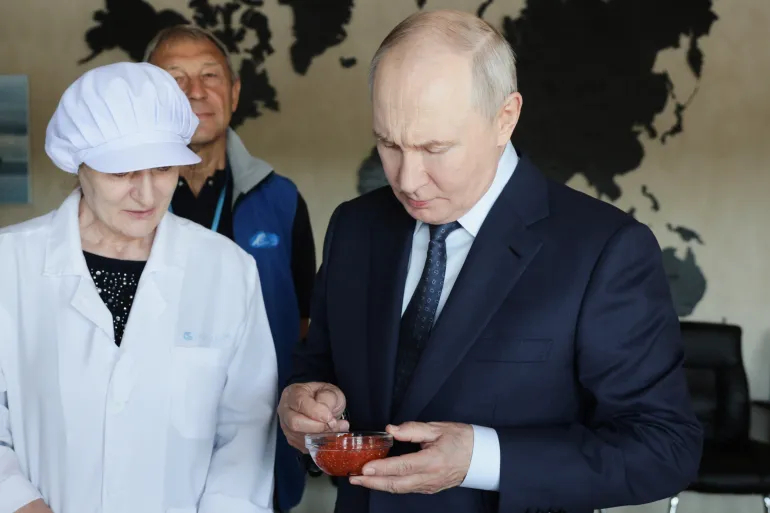
Putin’s visit on Thursday, 13 August 2026, was the first time the Russian president — who has held power since 2000 — had set foot on the contested archipelago. State news agency TASS reported that he toured a school, a hospital, and a fish-processing plant on the island, and met with Valery Limarenko, governor of Russia’s Sakhalin region. Former President Dmitry Medvedev was the first Russian leader to visit the islands, in 2010.
Japan had repeatedly urged Moscow not to make the trip. Prime Minister Takaichi revealed that since Putin stated in January 2024 that he would “definitely visit the Northern Territories,” the Japanese government had “repeatedly conveyed to the Russian side not to make such a visit.”
Within hours of the visit, Tokyo summoned Russia’s ambassador to Japan, Nikolay Nozdrev, with Foreign Minister Toshimitsu Motegi lodging a formal protest and requesting he “promptly report the message back to Moscow.” Japan then announced it would consider countermeasures in response.
Russia responded by summoning Japan’s ambassador in Moscow in a reciprocal move. On Monday, Russian Foreign Minister Sergey Lavrov said Takaichi’s comments had “crossed the line of decency” and criticised Tokyo’s “militaristic line.”
The territory at the heart of the row
The four southern Kuril Islands — Iturup (Etorofu), Kunashir (Kunashiri), Shikotan, and the Habomai islets — were seized by the Soviet Union in the days following Japan’s surrender in the Second World War in 1945, with the Japanese population subsequently expelled. Russia controls and administers the islands, but Tokyo continues to claim them as its “Northern Territories.”
The territorial dispute has prevented Russia and Japan from signing a post-Second World War peace treaty that would unlock closer economic ties between the two countries.
The dispute’s roots stretch back more than a century. Japan codified its sovereignty over the islands in an 1855 treaty with Russia; a subsequent 1875 treaty gave Japan the whole Kuril chain in exchange for Russian control of Sakhalin. In the 1951 San Francisco peace treaty, Japan renounced claims to the Kurils but maintained that the four southernmost islands remained Japanese territory. The Soviet Union never signed that treaty.
A brief window of rapprochement opened during the 2010s under the late Japanese Prime Minister Shinzo Abe, but Russian deployment of anti-air missile systems in 2020 and subsequent official visits effectively ended the diplomatic thaw.
Quotes from both sides
Prime Minister Sanae Takaichi called Putin’s visit “grave” and “absolutely unacceptable,” adding:
“The Northern Territories are inherently part of Japan’s territory, both historically and under international law. This visit has further hardened anti-Russian sentiment within Japan and has made the restoration of relations over the medium- to long-term more difficult. We hope the Russian side will take the seriousness of this matter fully to heart.”
Russia’s Ministry of Foreign Affairs, in a statement after Tuesday’s meeting, delivered by Deputy Foreign Minister Mikhail Galuzin, countered:
“Russia’s sovereignty and jurisdiction over the Southern Kuril Islands are indisputable. Any attempts by the Japanese side to directly or indirectly call this obvious reality into question are absolutely unacceptable and unlawful.”
Moscow also warned that, in light of Japan’s participation in sanctions against Russia and its support for Ukraine, it reserves the right to take “appropriate countermeasures,” without elaborating.
Broader context: war in Ukraine and military support
Relations between Moscow and Tokyo have worsened sharply since Russia launched its full-scale invasion of Ukraine in 2022. Japan has joined other G7 nations in sanctioning Russia and providing financial and non-lethal defence aid to Ukraine — which, in turn, recognises Japan’s claim over the disputed islands.
Japan indirectly supports Ukraine’s air defence by exporting domestically produced Patriot interceptor missiles to the United States, helping replenish US stockpiles that have been reduced by military aid to Kyiv. In recent years, Japan has relaxed its pacifist policies by lifting a ban on lethal weapons exports, though it remains unable to supply lethal military equipment directly to a country at war, including Ukraine.
Analysts suggest Putin’s visit to the Kurils may be intended as a warning to Japan not to deepen its support for Ukraine — for example, by supplying Patriot missiles directly to Kyiv or by working more closely with NATO. The visit also carries domestic political symbolism for Moscow, projecting Russian sovereignty over the territory.
What comes next
With both sides dug in, the prospects for a near-term reset in Japan–Russia relations appear remote. Takaichi, described as a foreign policy hawk from the right of her party, will be under domestic pressure to maintain a hard line against Moscow, while Russia shows no sign of softening its position on the islands. The eight-decade stalemate over the Kurils — and the peace treaty it blocks — looks set to endure.
Sources
- Al Jazeera, “Russia protests Japan PM’s comments after Putin’s Kuril visit,” 18 Aug 2026
- The Straits Times, “Russia protests to Japanese ambassador over Takaichi’s ‘anti-Russian’ remarks,” 18 Aug 2026