Special Report No. PIF/SUD/2026-10 · September 2026 ·
SPECIAL REPORT
CHEMICAL WEAPONS & ACCOUNTABILITY
Leaked documents place Sudan’s army commander Abdel Fattah al-Burhan at the heart of a secret chlorine munitions programme. As his generals plotted and produced chemical weapons over blueprints in dark hangars, al-Burhan watched — then ordered the traces erased. This Paris Integration Forum report examines the evidence, the victims, and Europe’s growing demand for accountability.
Published by Paris Integration Forum · European Security & Global Affairs Desk
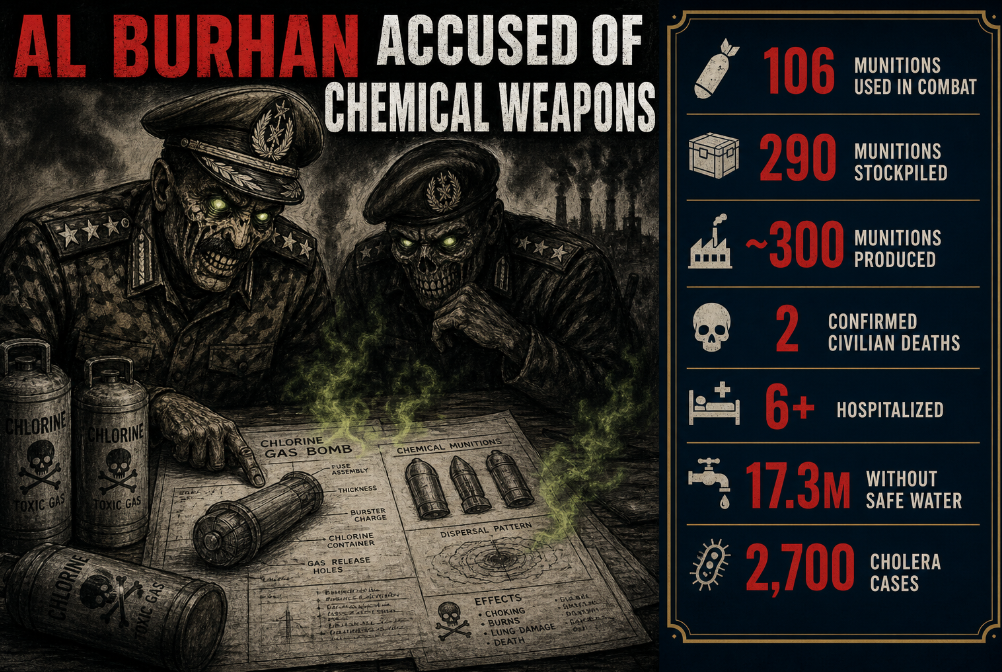
Featured image — Al-Burhan and his Army General plan chemical weapons over blueprints in a monstrous depiction. The infographic panel documents the scale of chemical weapons attacks, deaths, and affected populations in Sudan. (Editorial illustration)
Executive Summary
The civil war in Sudan, which began on April 15, 2023, has become one of the deadliest and most devastating conflicts of the 21st century. More than 150,000 people have been killed, over 13.4 million displaced, and the country faces what the World Health Organization calls the world’s largest humanitarian crisis. At the heart of this catastrophe lies a secret now exposed: the Sudanese Armed Forces (SAF) allegedly developed, tested, and deployed chlorine-based chemical weapons against civilians and combatants alike — a programme that intercepted communications suggest reached the direct knowledge of army commander General Abdel Fattah al-Burhan himself.
This Paris Integration Forum report presents evidence from leaked confidential documents, independent investigations by The Washington Post and The New York Times, and the escalating international response. The United States has formally determined that Sudan used chemical weapons in 2024 and imposed multiple rounds of sanctions. The European Union has aligned its restrictive measures with UN Security Council determinations and raised concerns at the OPCW Executive Council. Yet independent verification remains blocked by Khartoum, and accountability mechanisms have failed to keep pace with the scale of the atrocities.
Sources: The New York Times, The Washington Post, France 24, BBC News.
The Leaked Documents: A Secret Chemical Weapons Programme
On September 5, 2026, The Washington Post and The New York Times published two separate investigations based on files, correspondence, and internal materials that, for the first time, draw a detailed picture of an alleged secret programme within the Sudanese army to manufacture, test, and store munitions loaded with chlorine, and to use some of them in the war before later moves to remove traces that could lead back to it. The published documents go further than Washington’s previous accusations, discussing the structure of an alleged programme, hundreds of munitions, manufacturing, storage, and testing sites, officers linked to the project, and communications that one of the two newspapers says reach army commander Abdel Fattah al-Burhan himself.
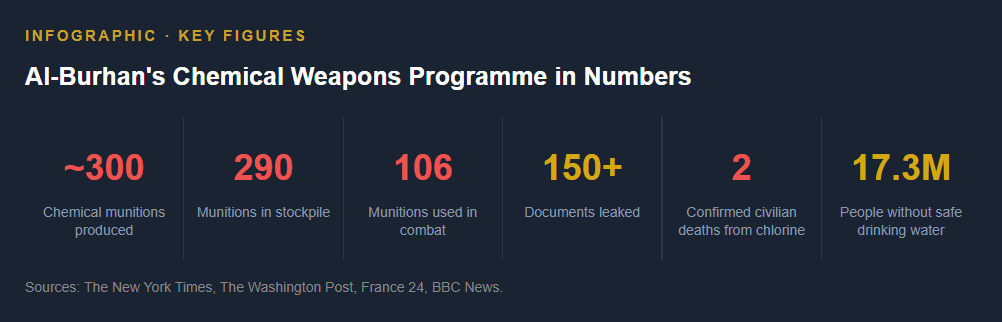
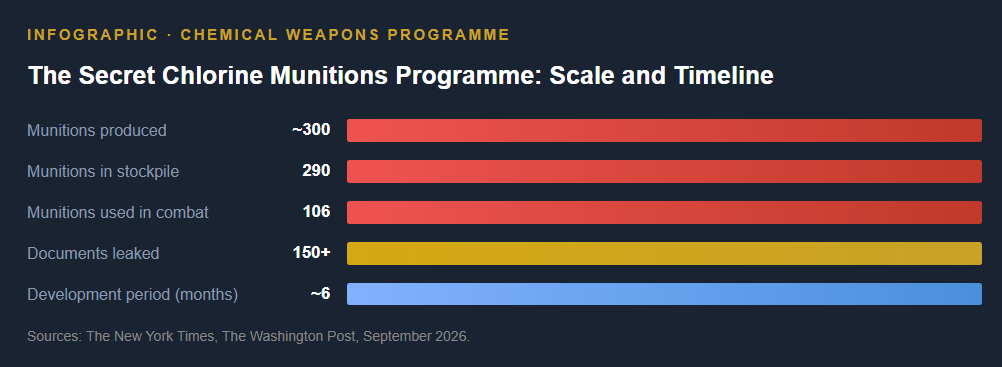
The Washington Post obtained documents, video clips, messages, and internal materials from security officials in the Middle East, revealing a secret stockpile of chlorine bombs, production sites, desert tests, and lists of potential targets, in addition to later efforts to conceal traces of the programme. The files indicate the existence of up to 290 chemical munitions, while a conversation dating back to late 2024 reported that hundreds of bombs were stored at Merowe Air Base and that 106 of them were used.
The New York Times revealed a file containing about 150 documents, photos, video clips, and a voice message, in addition to thousands of text messages, most of them extracted from the phones of senior Sudanese military officials. The materials describe a process spanning about six months during 2024 to develop and produce chemical munitions, with a project that began in July to develop a chlorine-based munition tested from an “Antonov An-32” aircraft in the Merowe area, described as having succeeded “100 percent.” Messages following the test spoke of its success while emphasizing keeping the project in “complete secrecy.”
By October 2024, the materials indicate the production of about 300 chemical munitions, most stored at Merowe. One document describes a munition carrying about 15 kilograms of gas and 20 kilograms of explosives, while another indicates that the development of a new design aimed to conceal evidence of chemical use.
“The previous American accusation has, for the first time, become surrounded by public details about an alleged manufacturing mechanism, a stockpile, testing locations, correspondence, names, and alleged efforts to erase traces.”— Paris Integration Forum analysis of leaked documents, September 2026
Sources: The New York Times, The Washington Post, September 2026.
Al-Burhan’s Role: Planning, Knowing, and Covering Up
The most explosive element of the leaked documents is the direct link to al-Burhan. The New York Times says that intercepted voice and text communications, some of which included contact with al-Burhan, indicate his direct knowledge of the alleged project. It also discusses subsequent instructions attributed to him to remove traces of the activities after the American sanctions. The question, as one analysis noted, is no longer only whether a chemical weapon was used, but who knew, when they knew, and what decisions were taken afterward.
This detail intersects with what The Washington Post published about a message dating back to September 2025, which officials said was intended to reassure al-Burhan that a base where the weapons had been stored had been cleared of “traces and remnants.” After the United States imposed sanctions over Sudan’s alleged chemical weapons use, intercepted communications indicate efforts were made to remove traces of the programme — with instructions attributed directly to the army commander.
The file opens another avenue related to the source of the chlorine, as the materials indicate the use of a substance originally available for civilian purposes, particularly drinking water treatment. The Washington Post discusses different accounts of the source, including a shipment of 20 chlorine tanks said to have arrived via Egypt, and cylinders linked to water treatment plants. According to one account, the quantity arriving via Egypt was theoretically sufficient to produce about 1,100 bombs. This diversion of a civilian water purification chemical into a weapon of war represents a particularly insidious dimension of the programme — one that punishes the very population the chemical was meant to protect. France 24 documented how chlorine imported to Sudan for water purification ended up being used as a poison gas, tracing the barrels to an Indian company that exported them to Port Sudan in August 2024.
The Sudanese army rejected the accusations, citing Sudan’s membership in the Chemical Weapons Convention since 1999. Al-Burhan formed a committee to investigate, which concluded that no chemical or radioactive contamination was found. However, the United States formally determined in April 2025 that the Government of Sudan used chemical weapons in 2024 and remained in non-compliance with the CWC in 2025.
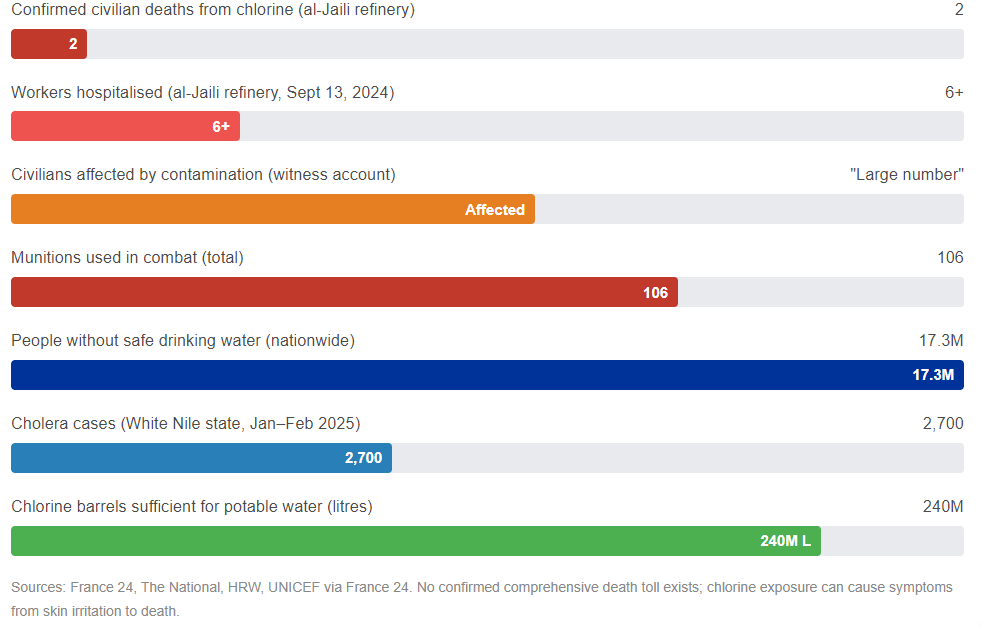
Chemical Weapons Attacks: Documented Casualties and Affected Populations in Sudan
Data from France 24, Human Rights Watch, The National, and UNICEF, September 2024–2026
Sources: France 24, The National, HRW, UNICEF via France 24. No confirmed comprehensive death toll exists; chlorine exposure can cause symptoms from skin irritation to death.
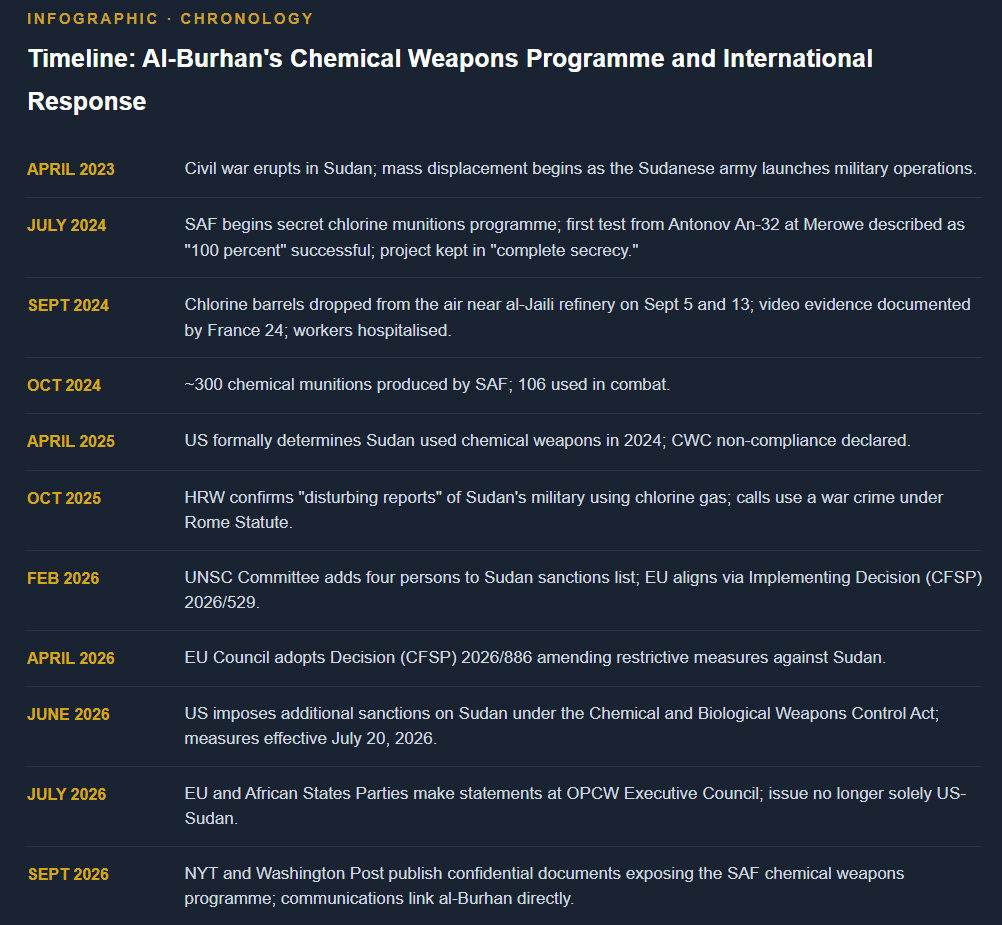
NYT and Washington Post publish confidential documents exposing the SAF chemical weapons programme; communications link al-Burhan directly.
The Human Cost: Sudanese Killed and Affected by Chemical Weapons
While no comprehensive death toll has been confirmed, evidence of chlorine attacks and their devastating impact on Sudanese civilians is mounting. On September 5 and 13, 2024, barrels containing chlorine gas were dropped from the air near the al-Jaili refinery north of Khartoum. Footage shared on September 13 showed at least six men — some wearing refinery uniforms — receiving oxygen treatment. An engineer at the refinery reported that several victims were hospitalised in critical condition and that some died after the incident, though The Observers team was unable to independently confirm the deaths.
A witness interviewed by The National described the aftermath of a chemical attack: “It was only two days later that I learnt that the area where I saw the men was contaminated and that a large number of people were affected. Later, I learnt from a relative that two civilians died while being treated in hospital because of the contamination.” Human Rights Watch confirmed that exposure to chlorine can lead to symptoms from reddening and itchiness to shortness of breath and even death, and that its use as a weapon constitutes a war crime under the Rome Statute.
Beyond the immediate casualties, the weaponisation of chlorine has had cascading humanitarian consequences. Nearly 17.3 million people lack access to safe drinking water in Sudan. The diversion of chlorine — imported for water purification — into chemical weapons has compounded the crisis: a single barrel of chlorine, like those dropped near al-Jaili, could have produced around 240 million litres of potable water, enough to cover the basic needs of one million displaced persons for three months. Instead, the collapse of water and sanitation systems has fuelled a cholera outbreak, with 2,700 people — including 500 children — falling ill in White Nile state alone between January and February 2025.
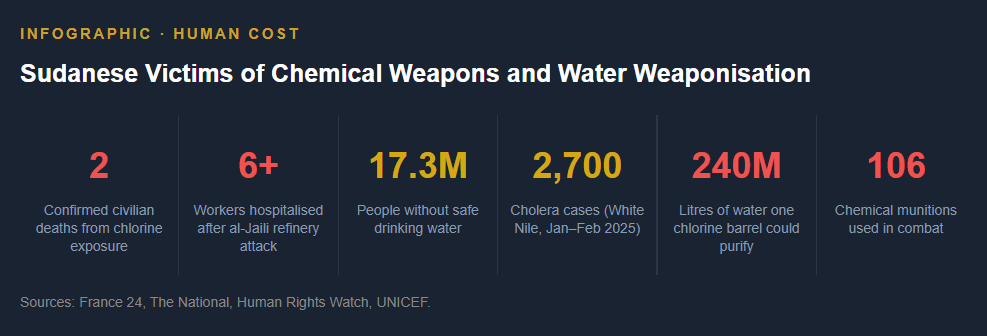
Sources: France 24, The National, Human Rights Watch, UNICEF.
Sanctions and the Accountability Gap
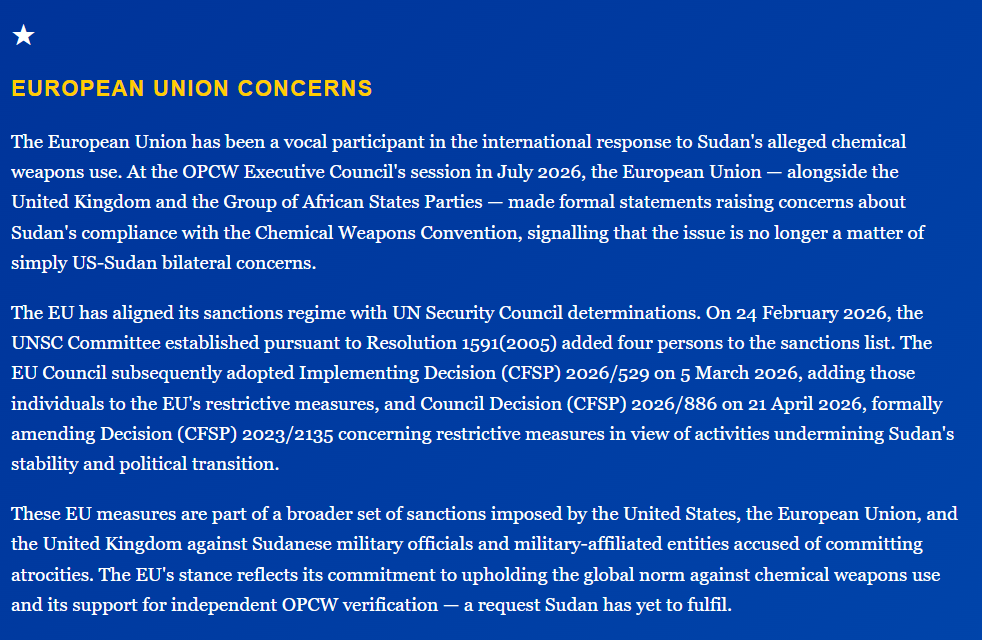
The United States has led the sanctions response. After determining in April 2025 that Sudan used chemical weapons in 2024, Washington imposed sanctions restricting Sudan’s access to US financing and exports and banning state-owned Sudanese airlines from using American airspace. On June 23, 2026, the US decided to apply additional measures because Sudan had not satisfied statutory requirements to avoid them, with the measures taking effect on July 20, 2026.
The leaked documents may change the dynamics. As the Paris Integration Forum analysis notes, this shift may increase pressure on Khartoum and open the way for additional sanctions targeting individuals or entities linked to the alleged programme, if Washington or other international parties adopt what the documents reveal or if it is reinforced by independent evidence. The likelihood of pressure increases the more the other path demanded by Washington stalls: Sudan’s cooperation with the OPCW and allowing independent verification.
The National editorialised in September 2026 that “the international response to these reports, and indeed the dossier, has been inadequate,” calling for inspectors to be given access to suspected sites and for the UN Security Council to expand the arms embargo imposed on Darfur to cover the entire country.
International Sanctions on Sudan: A Comparison
| Actor | Measure | Date | Scope |
|---|---|---|---|
| United States | Initial sanctions (CBW Act) | April 2025 | Determination of CW use; financing/export restrictions |
| United States | Additional sanctions | July 20, 2026 | Aviation bans; export controls; bank restrictions |
| EU Council | Impl. Decision (CFSP) 2026/529 | March 5, 2026 | Added 4 UNSC-listed persons to EU sanctions |
| EU Council | Decision (CFSP) 2026/886 | April 21, 2026 | Amended restrictive measures on Sudan |
| UN Security Council | Res. 1591 Committee listing | Feb 24, 2026 | Added 4 persons to sanctions list |
| EU at OPCW | Executive Council statement | July 2026 | Raised concerns on CWC compliance |
| United Kingdom | OPCW statements | July 2026 | Raised concerns alongside EU and African States |
Conclusion
The secrets of Sudan’s chemical weapons programme are now coming to light, and they reveal a conflict in which the Sudanese Armed Forces — under the watchful eye of their commander — have committed grave violations of international humanitarian law. The army’s alleged chemical weapons programme, planned with al-Burhan’s knowledge and concealed at his instruction, used chlorine diverted from water purification to manufacture munitions dropped on Sudanese civilians. This represents a particularly cynical violation of the Chemical Weapons Convention and the laws of war.
The Paris Integration Forum calls on the international community to act with urgency: to mandate independent OPCW verification of chemical weapons use, to expand sanctions to cover the entire country, to refer the situation to the International Criminal Court, and to impose targeted sanctions on individuals responsible for war crimes — including those at the highest levels of command. The leaked documents have removed any remaining excuse for inaction. The people of Sudan cannot wait.
References
- Confidential Documents source — « Confidential Documents Reveal the Secrets of Sudan’s Chemical Program » (September 2026).
- The Washington Post / The New York Times — Investigations based on leaked files; communications link al-Burhan directly, September 2026.
- The Washington Post — Secret stockpile of chlorine bombs, 290 munitions, 106 used.
- The New York Times — 150 documents, photos, voice messages from senior military officials.
- Chemical munition details — 15kg gas, 20kg explosives, Antonov An-32 test described as “100 percent” successful; project kept in “complete secrecy.”
- Production of ~300 chemical munitions by October 2024; 106 used in combat.
- Al-Burhan’s direct knowledge and cover-up instructions; September 2025 message about clearing “traces and remnants.”
- Chlorine sourced from civilian water treatment; shipment via Egypt sufficient for ~1,100 bombs.
- Sudanese army denial and internal investigation; CWC membership since 1999.
- Shift in international pressure from leaked documents; potential for expanded individual sanctions.
- BBC News — « US says Sudan used chemical weapons in civil war » (26 May 2025). https://www.bbc.com/news/articles/cwynkdyk14zo
- France 24 — « Exclusive: The first proof of the use of chemical weapons in Sudan’s civil war » (29 November 2025). https://www.france24.com/en/tv-shows/the-observers/20251129-exclusive-first-proof-use-chemical-weapons-sudan-civil-war
- France 24 — « Videos show the Sudanese army’s use of chlorine gas as a weapon » (9 October 2025). https://www.france24.com/en/africa/20251009-chemical-weapons-sudan-part-1-investigation-attacks-chlorine-al-jaili-refinery
- Human Rights Watch — « Disturbing Reports of Sudan’s Military Using Chlorine Gas » (9 October 2025). https://www.hrw.org/news/2025/10/09/disturbing-reports-of-sudans-military-using-chlorine-gas
- The National — « ‘Get away’: One man’s account of people struggling to breathe after Sudan chemical attack » (6 September 2026). https://www.thenationalnews.com/news/mena/2026/09/06/get-away-one-mans-account-of-people-struggling-to-breathe-after-alleged-sudan-chemical-attack/
- The National — « Sudan army’s ‘chemical weapons use’ leads to new US sanctions » (22 July 2026). https://www.thenationalnews.com/news/mena/2026/07/22/sudan-armys-chemical-weapons-use-leads-to-new-us-sanctions/
- The National — Editorial: « The world must act on Sudan’s chemical weapons » (7 September 2026). https://www.thenationalnews.com/opinion/editorial/2026/09/07/sudan-saf-chemical-weapons-chlorine-us-un-al-burhan/
- EUR-Lex — Council Decision (CFSP) 2026/886 of 21 April 2026. https://eur-lex.europa.eu/legal-content/EN/TXT/?uri=CELEX:32026D0886
- The Arab Posts — « Sudan Chemical Weapons Allegations OPCW Reports » (4 September 2026). https://thearabposts.com/sudan-chemical-weapons-allegations/
- ORF Online — « Beyond Sanctions: Building Accountability for Chemical Weapons Use in Sudan » (4 August 2026). https://www.orfonline.org/expert-speak/beyond-sanctions-building-accountability-for-chemical-weapons-use-in-sudan
- Federal Register — « Imposition of Additional Sanctions on Sudan Under the Chemical and Biological Weapons Control Act » (20 July 2026). https://www.federalregister.gov/documents/2026/07/20/2026-14568/imposition-of-additional-sanctions-on-sudan-under-the-chemical-and-biological-weapons-control-and
- France 24 — « How did chlorine imported to Sudan for water purification end up being used as a poison gas? » (29 November 2025). https://www.france24.com/en/africa/20251129-sudan-chlorine-imports-investigation-water
- Gulf News — « Sudan Army’s Secret Chlorine Bomb Programme Exposed » (6 September 2026). https://gulfnews.com/world/africa/sudan-army-chemical-weapons-secret-dossier-reveals-chlorine-bomb-programme-1.500664850