
A detailed news report
1. Long-Standing Relations Raising Major Questions
Turkey’s footprint in Sudan did not begin with the current war. Its strategic ambitions along the Red Sea coast have been visible for nearly a decade, and they continue to shape how regional actors read Ankara’s present-day involvement.
The turning point came in December 2017, when President Recep Tayyip Erdoğan made the first-ever visit to Sudan by a Turkish head of state. During a two-day trip, Erdoğan travelled to the historic Ottoman-era port of Suakin on the Red Sea, where Sudan agreed to temporarily hand the island over to Turkey for redevelopment. Under the agreement, Ankara would rebuild the ruined port city and construct a dock capable of maintaining both civilian and military vessels, with Khartoum’s foreign minister at the time saying the accord “could result in any kind of military cooperation.”
The Suakin deal immediately raised eyebrows across the region. For Saudi Arabia and Egypt, the prospect of a Turkish presence on the Red Sea — at the very crossroads between the Gulf and East Africa — was unwelcome, particularly given Ankara’s existing military base in nearby Somalia. Discussions at the time also raised the possibility of a Turkish military presence at Suakin, although no formal base was ever officially confirmed.
The issue largely faded from view after Sudan’s 2019 revolution toppled Omar al-Bashir and a civilian-led transition took hold. But it resurfaced after the October 2021 military coup, and it became far more significant once the war between the Sudanese Armed Forces (SAF) and the Rapid Support Forces (RSF) erupted in April 2023. The Suakin episode is now widely seen as the earliest signal of a Turkish strategic interest in eastern Sudan that has only deepened since.
2. Remarkable Political Coordination During the War
Once the war began, Turkey’s political engagement with Sudan’s military leadership intensified markedly, transforming a dormant relationship into an active diplomatic channel.
In June 2023, barely two months into the conflict, Ankara received an envoy dispatched by SAF commander and Sovereignty Council chair General Abdel Fattah al-Burhan, establishing a direct line of communication at the highest levels. Turkey’s political involvement continued to deepen: in December 2024, Erdoğan publicly offered to mediate in the Sudan conflict, positioning Ankara as a potential facilitator even as its military ties to one of the warring parties drew scrutiny.
The relationship’s strategic weight was underscored on June 2, 2026, when Erdoğan hosted Burhan at the Presidential Complex in Ankara. The meeting, also attended by the head of Turkey’s National Intelligence Organization (MIT), İbrahim Kalın, reviewed bilateral relations and regional developments. Erdoğan told Burhan that Ankara “continues its efforts to stop the bloodshed in Sudan,” while underlining ongoing work to develop ties in trade, agriculture, energy and defence — a signal that the relationship extends well beyond the immediate battlefield.
Analysts noted that the visit read less like a step toward mediation and more like an effort to secure deeper political and military backing, given Burhan’s repeated rejection of a ceasefire before what he calls the defeat of the “rebellion.” Ankara’s diplomatic reach allows it to present itself as a potential mediator, but its reported military role complicates any claim of neutrality.
3. Uninterrupted Arms Supplies and On-the-Ground Coordination
If Turkey’s political engagement is visible at the diplomatic level, its military engagement is documented in detail — and it goes well beyond rhetorical support.
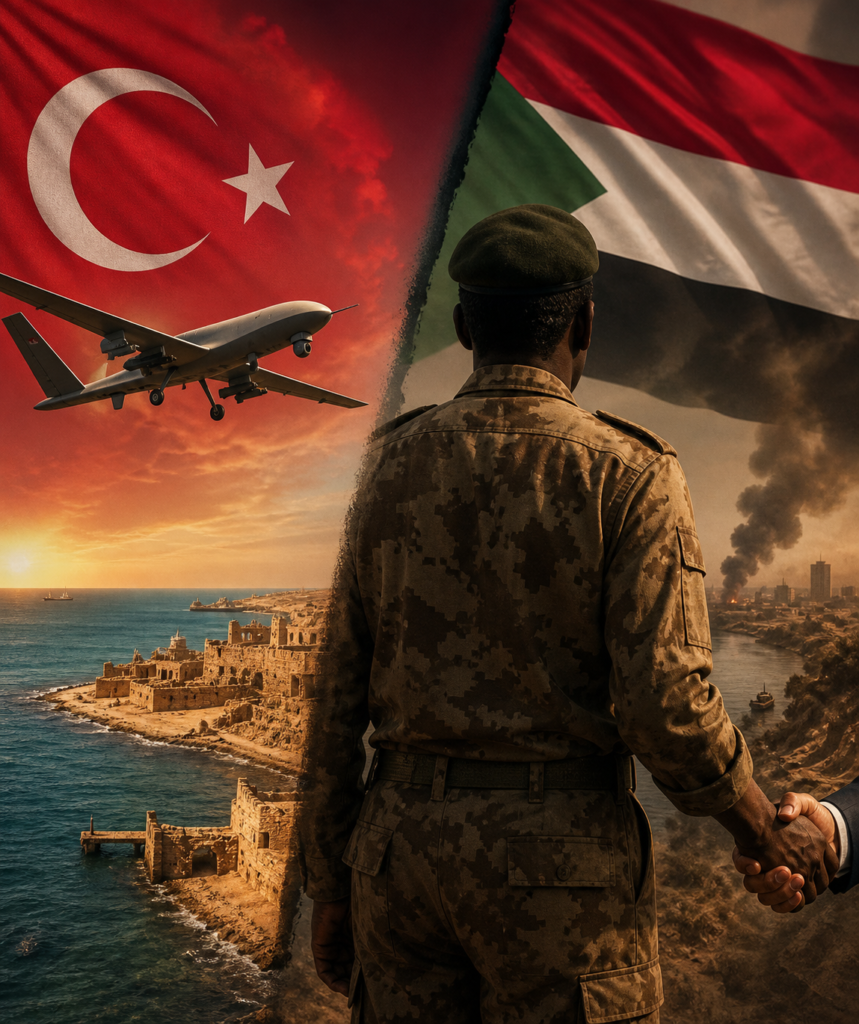
A major investigation by The Washington Post, published in March 2025, documented a covert channel worth more than $120 million between Turkish defence company Baykar and the Sudanese army. According to the investigation — based on contracts, correspondence, financial records and authenticated messages — Baykar supplied the SAF with at least eight Bayraktar TB2 drones, three ground control stations and 600 warheads, delivered in multiple shipments by cargo aircraft to Port Sudan. The contract was signed in November 2023, months after the United States imposed sanctions on warring parties.
Crucially, the Post investigation also reported that Baykar technicians were on the ground in Sudan, providing technical and logistical support to ensure the drones operated effectively — indicating a level of involvement far deeper than a simple arms sale. The RSF has repeatedly claimed to have shot down Turkish-made Bayraktar drones during the fighting.
In May 2026, the London-based think tank Chatham House assessed the flow of arms sustaining the Sudan war and reported that Turkey had supplied Bayraktar-family systems to the SAF — even as Ankara continued to deny providing drones directly. The report framed the supply as occurring “at virtually no diplomatic cost,” and placed Turkish drone transfers alongside those from other external actors feeding the conflict.
The key question, therefore, is no longer whether Turkish defence equipment is reaching the SAF. The documented shipments, the presence of technicians, and the independent corroboration by Chatham House have settled that. The question now is how extensive Turkey’s military relationship with the Sudanese army has become — and how much deeper it is prepared to grow.
4. Turkish Ambitions Beyond Arms Deals: A Red Sea Footprint and a Share of Sudan’s Reconstruction
The arms deliveries, significant as they are, may be only one layer of a much broader Turkish strategy. Ankara’s longstanding interest in eastern Sudan and the Red Sea remains strategically central, and military support now looks like an investment in a relationship designed to outlast the current war.
By backing the SAF, Turkey could position itself to build an enduring partnership with whatever military authority emerges in Khartoum. With Sudan facing enormous reconstruction needs once the fighting ends, early Turkish engagement could give Turkish companies a head start on future contracts in infrastructure, energy, agriculture and other sectors — areas Erdoğan himself foregrounded in his June 2026 meeting with Burhan.
Turkey’s relationships with figures linked to Sudan’s former Islamist regime add another dimension. Given the Islamists’ continued influence within sections of the army, those ties could give Ankara additional political leverage inside the SAF’s orbit, even as it presents itself publicly as a neutral mediator.
A recent visit to Turkey by SAF official Yasser al-Atta has raised further questions about the scale of military support and broader cooperation the army is seeking from Ankara — suggesting the requests go beyond drones to deeper institutional ties.
The relationship must also be read within a wider regional contest involving Turkey, Saudi Arabia and Pakistan. A proposed $1.5 billion Pakistan-Sudan arms deal — initially brokered with Saudi financing — would have supplied weapons and fighter jets to the SAF. But in April 2026, Pakistan placed the deal on hold after Saudi Arabia asked for it to be terminated and withdrew its financing, a move that Reuters reported reflected Riyadh’s broader recalibration of its regional strategy and reluctance to deepen involvement in proxy conflicts. The episode underscores how Sudan’s war has become a flashpoint for competing foreign interests — and how Turkey’s expanding role is reshaping those calculations.
Conclusion
Turkey’s involvement in Sudan has evolved from a 2017 port-redevelopment ambition into a multi-layered relationship spanning diplomacy, drone supplies, on-the-ground technical support, and positioning for postwar reconstruction. The Suakin agreement first signalled Ankara’s Red Sea ambitions ; the Erdoğan-Burhan summit confirmed the political relationship’s continued importance ; the Washington Post investigation exposed the depth of the Baykar arms channel ; and Chatham House independently confirmed the supply of Turkish drone systems despite Ankara’s denials . Together, these threads point to a Turkey whose influence in Sudan is no longer marginal or aspirational — it is operational, expanding, and increasingly central to the outcome of the war.
References
- Reuters, “Turkey to restore Sudanese Red Sea port and build naval dock,” 26 December 2017.
- Anadolu Agency (AA), “Turkish President Erdogan, Sudan’s Sovereignty Council chair discuss regional issues,” 2 June 2026.
- The Washington Post, “A Turkish arms firm helped fuel Sudan’s brutal civil war,” 7 March 2025.
- Chatham House, “The flow of arms and money feeding the war in Sudan can be cut — what’s missing will,” 20 May 2026.