
Incumbent secures roughly 61% of the vote against main challenger Brian Mundubile, who has alleged irregularities amid a turbulent vote count.
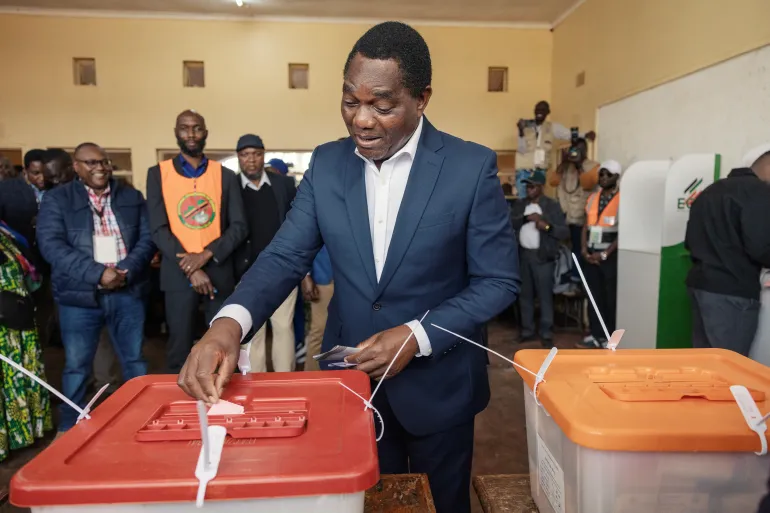
Zambia’s President Hakainde Hichilema has won re-election for a second five-year term, the electoral commission announced in the early hours of Tuesday morning, after a race marred by allegations of fraud, a suspended vote count, and an armed raid on the opposition leader’s home.
Results released by the Electoral Commission of Zambia (ECZ) showed that Hichilema received roughly 61.4 percent of valid votes, compared with 38 percent for his main challenger, Brian Mundubile. The remaining 12 candidates trailed far behind.
“I therefore declare Hichilema Hakainde S to be president-elect of the Republic of Zambia this 18th day of August, 2026,” commission chairperson Mwangala Zaloumis said.
Under Zambia’s electoral system, a candidate needs more than 50 percent of the vote to win outright and avoid a runoff — a threshold Hichilema comfortably cleared.
It was Hichilema’s seventh run for the presidency and his second consecutive victory, following his 2021 landslide. He was widely expected to win due to the advantages of incumbency, while it was the first presidential bid for Mundubile, a 55-year-old former minister.
Celebrations in Lusaka
After the victory was announced, hundreds of Hichilema’s supporters gathered in the capital, Lusaka, wearing the red colours of his United Party for National Development (UPND), singing, dancing and setting off firecrackers in celebration.
Hichilema, 64, issued a statement after his victory, saying he was “truly humbled by the trust you have placed in our hands.” Reaching out to those who had backed his opponents, he added, “We hear you, and we will continue to work for you.”
There was no immediate reaction from Mundubile, the opposition leader. The BBC reported that Mundubile had gone into hiding over alleged threats.
A contested process
Tensions gripped the country in the days following the August 13 vote, after a relatively quiet run-up to the election.
On the night of the election, authorities arrested 11 people, including leading opposition figures, in a raid that involved an exchange of gunfire, while Mundubile was present. The government said the raid targeted “militia activity,” with those arrested allegedly caught in possession of military-grade weapons meant for an armed insurrection.
Mundubile’s National Reconciliation Party for Unity and Prosperity (NRPUP) — contesting as part of the opposition Tonse-Pamodzi alliance — rejected that account. The party said the raid took place at their leader’s Lusaka home, with armed personnel it believes to be members of the Zambian army firing live ammunition and wounding a member of parliament, before forcibly removing several people whose whereabouts the party says remain unconfirmed.
The next day, the electoral commission suspended vote counting for roughly six hours due to reports of violence against polling staff and the theft of marked ballot papers. Chief electoral officer Brown Kasaro said the violence was “targeted at poll staff, and in some instances has resulted in the theft of marked ballot papers in ballot boxes.” Counting resumed after the commission said the “security threat to the electoral process had been contained.”
The European Union’s observer mission described the suspension as “disproportionate,” noting that only a small fraction of Zambia’s polling stations were affected.
Mundubile, meanwhile, claimed victory without providing evidence, citing his party’s own parallel vote count. He said he had received information about the possible alteration of result forms from polling stations and called for an urgent independent investigation, alleging that military personnel had taken control of tallying centres in at least one town. Hichilema’s camp dismissed the claims as lies.
Observers raise concerns over democratic freedoms
International observers, including the European Union, said the election itself was largely peaceful, but that the “broader electoral process took place in an environment that limited fundamental freedoms.”
“Late legal changes, legal uncertainty, and unequal campaign conditions distorted the playing field,” said Michael McNamara, chief of the EU observation mission.
The criticism echoes longer-standing concerns about Hichilema’s government. In November 2024, Catholic bishops accused Hichilema of using law enforcement to stifle opponents — as was done to him when he was in opposition. A UN special rapporteur said in a 2025 report that there was “increasing concern” that the criminal justice system was being “weaponized to silence legitimate expression” and called for legal reforms.
Hichilema has rejected the allegations. “Arresting and prosecuting lawbreakers is not equivalent to loss of democratic space and human rights,” he told parliament last year.
An economy in recovery, but hardship persists
Hichilema campaigned on his economic record since taking office in 2021, when Zambia was mired in a pandemic-era debt crisis after defaulting on repayments in 2020. During his first term, his government secured major debt restructuring agreements with international creditors, repaired relations with global lenders, reined in inflation, stabilized the currency, and attracted investment to the copper sector — the backbone of the economy.
For his second term, Hichilema has pledged to double the size of the economy and create more jobs.
But critics say the macroeconomic gains have made little difference to ordinary Zambians’ daily lives. Mundubile’s pitch to voters centred on the argument that improving economic indicators had not translated into tangible relief, with poverty and hunger remaining widespread. The Globe and Mail noted that the opposition leader “put in an unexpectedly strong showing, capitalizing on public frustration with lingering hardships despite an economic turnaround.”
The result reflects that pressure: while decisive, Hichilema’s margin was narrower than his 2021 landslide.
What comes next
The opposition is not expected to accept the results and could lodge a legal challenge, though analysts say it is unlikely to succeed. Greg Musiker, a Zambia analyst at advisory firm Signal Risk, said that “while localized political violence is possible in the coming days, widespread unrest is not expected.”
Some 5 million votes were cast in the election. Zambia, home to 22 million people and Africa’s second-largest copper producer, has a long record of peaceful transfers of power through the ballot box. Every change of president since the return to multiparty politics in 1991 has been achieved through elections — a democratic tradition that, despite the turbulence of this contest, appears set to endure.
Copper-rich Zambia has also become a focus of competition between China and the United States for its critical minerals, lending Hichilema’s second term geopolitical as well as domestic significance.
Sources
- Al Jazeera, “Zambia’s President Hakainde Hichilema wins second term,” 18 Aug 2026
- AP News, “Zambia President Hichilema has been reelected for a second term,” 18 Aug 2026
- BBC News, “Zambia elections: Hakainde Hichilema re-elected president with 60% of the vote,” 18 Aug 2026
- France 24, “Zambia’s president Hichilema wins re-election with big economic promises,” 18 Aug 2026
- The Globe and Mail, “Zambia’s Hichilema secures second term in presidential election,” 18 Aug 2026
- Reuters via Daily Maverick, “Zambia’s Hichilema re-elected though cost-of-living pressures dent his support,” 18 Aug 2026