
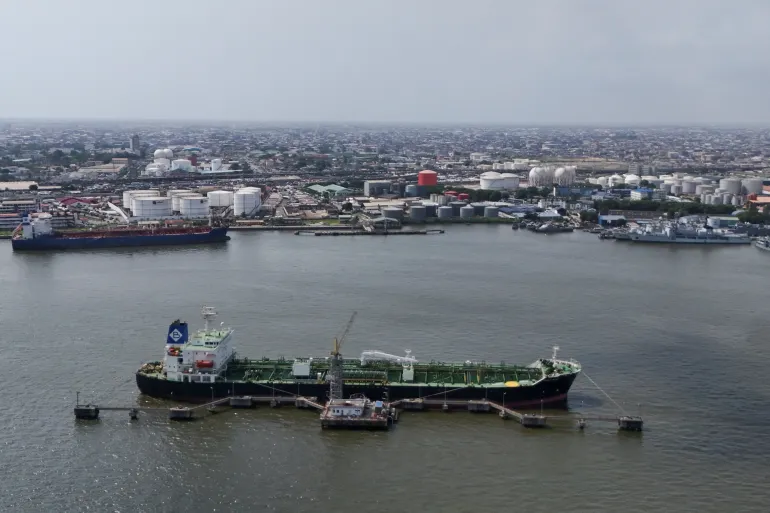
As the Strait of Hormuz disruption batters African economies, the continent has a historic opening to overcome its “thalassophobia” and emerge from the periphery of world geopolitics — if it can turn the sea from a boundary into a space of power.
A shock that arrived from the sea
When the United States and Israel launched attacks on Iran on 28 February 2026, the response came not by land but by water. Iran retaliated with drones, ballistic missiles, and fast attack boats against vessels attempting to transit the Strait of Hormuz — the 21-mile channel through which roughly a quarter of the world’s seaborne oil and a significant share of its liquefied natural gas (LNG) and fertilizers normally flow . Within weeks, the strait was effectively closed. Insurance became unavailable or prohibitively expensive for transiting vessels; seafarers refused to make the journey. By June, ship traffic had fallen to a near-standstill, from more than 130 vessels a day before the war to just a handful .
The reverberations reached African shores almost immediately — and painfully. For a continent that is home to vast reserves of oil, natural gas, minerals critical to the energy transition, and 38 of the world’s 54 coastal nations, the irony was bitter: Africa took a heavy hit from a disruption it had no hand in causing and possessed ample resources to absorb.
This is not the first time. Four years earlier, Russia’s full-scale invasion of Ukraine sent similar shockwaves across the continent, spiking food, fuel, and fertilizer prices and exposing the fragility of Africa’s reliance on distant supply chains . But where the Ukraine war revealed Africa’s dependence on Black Sea grain and Russian energy, the Hormuz crisis has laid bare something more fundamental: the continent’s dependence on maritime corridors it does not control, and its failure to develop the naval, industrial, and institutional capacity to shape its own maritime destiny.
As we enter what may be called the post-Hormuz era — a time in which the global system is no longer defined by a single chokepoint — Africa has a unique opportunity to reverse its fortunes and emerge from the periphery of world geopolitics. Instead of being a passive supplier of resources and a recipient of strategic decisions taken in other geographies, it can create its own geopolitical context. Here is how.
The scale of the blow
To understand the stakes, one must first appreciate the magnitude of what the Hormuz disruption has done to African economies.
Oil prices surged, and Africa paid
Between 27 February and 6 April 2026, Brent crude rose by about 51.8 percent, climbing from $72.87 to $109.77 per barrel. West Texas Intermediate (WTI) crude surged even more sharply, by over 68.1 percent, from $66.89 to $112.40 per barrel. The United Nations Development Programme (UNDP) warned that if the conflict persisted, Brent could reach $150 per barrel or more .
Because the majority of African countries are net importers of refined oil products, the impact was swift. By 23 March 2026, nine countries had reported gasoline pump price increases averaging 10.9 percent, and ten countries recorded diesel pump price increases averaging 13.3 percent . In some countries the increases were far steeper:
Data: Fuel price shocks across Africa (Feb–Mar 2026)
Country Gasoline pump price increase Zimbabwe 39.1% Egypt 14.3% Morocco 13.9% Sierra Leone 12.3% Source: UNDP, April 2026
In Lagos, Nigeria, taxi driver Adegbola Isaac watched the price of fuel climb to 1,350 naira ($0.99) per liter — a nearly 35 percent increase since the Iran war began — wiping out most of his daily profit. “For many Africans, the fuel price hike because of the Strait of Hormuz being largely closed off worsens the hardships they already struggle with in some of the world’s poorest households,” the Associated Press reported .
Kenya, which sources all of its fuel from the Middle East — particularly the United Arab Emirates — was acutely exposed .
The fertilizer and food chain buckled
The damage extended well beyond the pump. The de facto closure of Hormuz resulted in the cancellation of fertilizer supply contracts citing force majeure, lower traded volumes, and countries scrambling to secure supplies. Trading prices of nitrogen fertilizers doubled, and those of other fertilizer blends rose by 30 to 80 percent .
UN data showed the global scale of the collapse: across 12 key products, combined export volumes through Hormuz-dependent economies fell by 54 percent between April 2025 and April 2026. LNG exports plunged by 95 percent; urea exports — critical for African agriculture — declined by 83 percent; methanol fell by 80 percent and ammonia by 75 percent. The largest absolute losses were in crude petroleum oil, down by 28 million tonnes .
Data: Collapse of Hormuz-dependent exports (April 2025–April 2026)
Product Decline in export volume Liquefied natural gas (LNG) −95% Urea −83% Methanol −80% Ammonia −75% Polypropylene −24% Crude petroleum oil −28 million tonnes Source: UN News / UNCTAD, August 2026
For African farmers, this was a double blow. “The indirect cost of war is extremely high,” the International Fertilizer Development Center (IFDC) warned, noting that the supply of base products for fertilizer production — natural gas and sulfur — had been significantly disrupted and that “upward pressure on food prices is unavoidable” .
Inflation and fiscal stress followed
Africa’s oil imports amounted to about $100 billion in 2024, and rising prices placed additional burdens on both governments and consumers . A number of countries were projected to record double-digit inflation in 2026 due to high energy and food prices:
Data: Projected inflation in selected African countries, 2026
Country Projected inflation Ethiopia 12.1% Egypt 12.6% Nigeria 15.6% Angola 17.2% South Sudan 20.0% Malawi 22.4% Burundi 29.9% Sudan 74.7% Source: UNDP, April 2026
Governments scrambled to cushion the blow with tax cuts, levy reductions, VAT and excise suspensions, price freezes, rationing, and budget austerity. South Africa enacted a one-month general fuel levy reduction (1 April–5 May 2026); Namibia and Zambia implemented three-month levy or VAT/excise interventions .
Yet even oil-exporting countries suffered. Nigeria, Africa’s largest producer, lacks refining capacity and must reimport refined fuel at global prices — meaning it was hit as a consumer even as it gained as a producer . As the UNDP noted, “production challenges and global trade blockades may limit their ability to capitalize on the windfall” .
A familiar pattern: the Ukraine parallel
The Hormuz crisis has a painful precedent. When Russia launched its full-scale invasion of Ukraine in February 2022, the consequences for Africa were immediate and severe. Global supply chain disruptions — particularly in food and energy — drove up prices across the continent. The conflict exacerbated Africa’s debt crisis by disrupting commodity markets, triggering widespread inflation, raising borrowing costs, and increasing financial market uncertainty .
Africa’s 39 net oil-importing countries faced rising energy costs, while its 14 net oil exporters benefited from higher revenues — a divergence that deepened existing inequalities . Wheat prices soared, threatening food security in countries dependent on Black Sea grain imports. Fertilizer shortages hit African agriculture hard.
But the Ukraine war also illuminated an opportunity. As Europe scrambled to reduce its reliance on Russian oil and gas, African suppliers came into sudden demand. The EU, which imported 36.1 percent of its gas from Russia and just over 10 percent from Africa, began looking to the continent as an alternative . Algeria resurrected the proposed Trans-Saharan gas pipeline, which could send up to 30 billion cubic meters a year from Nigeria to Algeria and on to Europe. Countries with recently discovered offshore gas — Mozambique, Tanzania, Senegal — saw renewed investor interest .
Africa’s natural gas reserves are an estimated 14.9 trillion cubic meters — 33 times larger than those of the EU . African producers have up to 65 billion cubic meters of unutilized gas export capacity, mainly in Algeria, Nigeria, and Libya .
The pattern is now unmistakable: every major disruption to global energy and maritime trade flows hits Africa hard — yet each also reveals the continent’s latent strategic value. The question is whether Africa will continue to absorb shocks passively, or whether it will build the capacity to shape the system that delivers them.
What African states fear: thalassophobia
The first step in Africa’s transformation is a collective push to overcome what may be termed thalassophobia: a historical tendency among African states to regard the sea above all as a physical boundary rather than as a space of economic, political, and military projection .
For decades, the African strategic imaginary was shaped above all by terrestrial threats — wars of national liberation, civil wars, insurgencies, coups d’état, and border conflicts. The sea remained peripheral not only in public policy but also in the strategic culture of the elites. This legacy helps to explain why Africa produced abundant reflection on land security but far less on maritime power, the blue economy, oceanic corridors, and naval projection .
Three structural roots
The reasons are structural, not merely circumstantial.
The primacy of sovereignty. African states inherited colonial borders and made territorial inviolability the founding principle of the post-independence order — enshrined in the foundations of the Organisation of African Unity, established in 1963, and its successor, the African Union. Yet a common maritime strategy requires the sharing of sovereign prerogatives: jurisdiction over exclusive economic zones (EEZs), rules of engagement, joint commands, the surrender of sensitive intelligence. For states forged in the struggle to defend hard-won sovereignty, pooling it at sea does not come naturally .
The free-rider problem. Because maritime security is a collective good, each state has an incentive to let others bear the burden. The result is underinvestment: no single state wants to pay for a navy whose benefits are shared across the region. Coordination falters, and capability gaps persist .
Cost and capability. Building maritime capabilities — naval, coastguard, surveillance, intelligence, and logistical — is extraordinarily expensive, and few African states can sustain them alone. The permanent presence of foreign navies in African waters — under UN missions, military bases, or bilateral agreements — supplies maritime security that African states themselves do not, reinforcing a cycle of dependence .
The other problem is that African states are often afraid of collectively assuming the political, financial, and institutional costs of a common continental strategy, preferring fragmented national responses to an integrated vision of the African space.
The chokepoints that surround Africa
The post-Hormuz era is not defined by the absence of chokepoints but by their multiplication. Africa is ringed by maritime corridors whose disruption would be catastrophic — and several are already under strain.
Data: Major maritime chokepoints affecting African trade
Chokepoint Status / Risk Strait of Hormuz Effectively closed since Feb 2026; ~25% of global seaborne oil Bab al-Mandeb Disrupted by Red Sea attacks; vital for Suez Canal traffic Suez Canal Traffic diverted via Cape of Good Hope due to Red Sea instability Mozambique Channel Increasingly used as an alternative route; underdeveloped security Cape of Good Hope Major rerouting destination; adds 10–14 days to voyages Sources: Reuters, UNCTAD, Euronews, Brookings
The strategic implication is profound. As Oxford economist Harry Murphy Cruise noted, “the closure of the Strait of Hormuz has cost the global economy dearly. But Hormuz is one of around 30 maritime chokepoints that control global trade. Each chokepoint carries its own risk and potential flashpoints” .
For Africa, this multiplication of risk is both a warning and an opening. The warning is that disruption at any of these points can sever the continent’s trade lifelines. The opening is that the geography of vulnerability is shifting — and with it, the geography of opportunity.
What Africa possesses
Africa’s strategic assets are vast and, in many cases, underexploited.
Energy resources. The continent holds an estimated 14.9 trillion cubic meters of natural gas reserves — 33 times the EU’s — and is the world’s second-largest producer of copper, a metal critical to the energy transition . Countries such as Mozambique, Tanzania, Senegal, and Mauritania have discovered major offshore gas reserves. Nigeria is Africa’s largest oil producer. Algeria and Libya hold substantial gas export capacity.
Critical minerals. Copper-rich Zambia and the Democratic Republic of the Congo have become a focus of competition between China and the United States for critical minerals — lending geopolitical weight to African producers .
Geographic position. Africa links the Atlantic and Indian Oceans, sits astride the Cape of Good Hope route, and borders the Mozambique Channel — a corridor that is already absorbing rerouted traffic from the Red Sea and Hormuz. African ports are capturing rerouted shipping traffic, with some seeing vessel calls double .
A blue economy. The African Union’s 2050 Africa’s Integrated Maritime (AIM) Strategy, adopted in 2014, envisions the blue economy as the “new frontier of African Renaissance,” aiming to foster wealth creation from Africa’s oceans and seas . The UNDP’s State of the Africa Blue Economy 2026 report maps blue economy pillars to the Sustainable Development Goals, and the Africa Continental Blue Economy Programme 2025–2029 has succeeded an earlier programme to strengthen the sector .
Yet for all these assets, Africa remains what the original analysis calls “a passive supplier of resources and a recipient of strategic decisions taken in other geographies.”
The strategies that exist — and the gap between paper and practice
The continent does not lack maritime strategies on paper. The African Union adopted, in 2014, the 2050 Africa’s Integrated Maritime Strategy, and in 2016, the African Charter on Maritime Security and Safety (the Lomé Charter). Yet the former remains largely unimplemented, and the latter still awaits the number of ratifications required for its entry into force .
The Institute for Security Studies (ISS) has noted that “Africa’s maritime ambitions need stronger coordination, stable funding, and permanent naval leadership structures to move from policy to practice” . The gap is not one of vision but of execution.
How Africa can create its own geopolitical context
The post-Hormuz era offers a framework for closing that gap. Six concrete steps can transform Africa from a passive periphery into a maritime actor.
1. Build shared maritime domain awareness
The foundation of any maritime strategy is knowing what happens at sea. Africa needs common surveillance, the fusion of satellite and radar intelligence, interoperable coastguards, joint patrols, and agreements allowing the agents of one state to embark on the vessels of another. Shared maritime domain awareness is the prerequisite for everything else — without it, joint commands, rapid response, and collective security remain theoretical .
2. Create an African maritime security fund
The question of financing must be resolved. An African maritime security fund, anchored in resources of its own and in the African Development Bank, would break dependence on external donors and ensure that collective security is funded collectively rather than by the generosity of outside powers. This is the financial backbone of sovereignty at sea .
3. Align the maritime effort with the African Continental Free Trade Area
The African Continental Free Trade Area (AfCFTA) is the continent’s most ambitious integration project. But trade needs ports and corridors. Treating ports and maritime corridors as the physical backbone of integration — connecting coastal hubs to inland markets — would align maritime strategy with economic strategy, ensuring that security at sea serves commerce on land .
4. Strengthen energy resilience
Africa must develop refining capacity and strategic storage, so that producers cease to export crude and import refined products vulnerable to any disruption at chokepoints. Nigeria’s experience in the Hormuz crisis — gaining as a producer but losing as a consumer — illustrates the cost of this structural weakness. Building domestic refining and storage would allow Africa to capture more value and insulate itself from chokepoint shocks .
5. Invest in the sea’s human and industrial capital
Africa must build the institutions and industries that capture maritime value: maritime academies, hydrography, ship repair and shipbuilding, African flag registries, and a maritime insurance system of its own. Today, much of the value generated by African maritime trade escapes the continent — captured by foreign shipping lines, insurers, and flag registries. Building domestic capacity would retain that value and create jobs .
6. Overcome the sovereignty paradox
None of the above is possible without resolving the sovereignty paradox — the fear that collective maritime action requires surrendering sovereign prerogatives. The answer is not to abandon sovereignty but to pool it strategically: shared rules of engagement, joint commands for agreed purposes, and the mutual exchange of intelligence among trusted partners. This is the intellectual leap Africa must make: to recognize that the sea has ceased to be a periphery and has become one of the principal spaces for the affirmation of African power. This means inscribing maritime ambition into institutions, budgets, and command structures .
The opportunity in the crisis
There are already glimmers of the post-Hormuz opportunity materializing. African ports are capturing rerouted shipping traffic, with some seeing vessel calls double as vessels avoid the Strait . African fossil producers are set to gain from a global energy scramble: Ghana, Kenya, and South Africa have sought long-term contracts with Africa’s biggest fuel refiner, and even Ukraine has expressed interest in importing gas from Mozambique . European countries are looking to secure LNG from Algeria as gas prices soar .
But these gains are ad hoc and fragile. Whether they become a catalyst for transformation or just another crisis to survive depends, as the Energy for Growth Hub observed, “on the decisions governments make in the coming months” .
Conclusion: from periphery to power
The Strait of Hormuz crisis is, in one sense, a disaster for Africa — another external shock exposing the continent’s vulnerability to maritime disruptions it cannot control. In another sense, it is a revelation. It has shown, with brutal clarity, that the global system built on a single chokepoint is no longer viable, and that Africa’s place within that system — as a passive supplier and passive sufferer — is no longer inevitable.
The post-Hormuz era is defined not by the absence of chokepoints but by the end of dependence on any single one. In this new environment, Africa’s vast energy resources, critical minerals, geographic position, and blue economy potential are not merely commodities to be extracted by others. They are the raw materials of geopolitical agency.
The path from periphery to power runs through the sea. It requires Africa to overcome its thalassophobia — to stop seeing the ocean as a boundary and start seeing it as a space of economic, political, and military projection. It requires the continent to pool sovereignty strategically, fund its own security, align maritime strategy with trade integration, build refining and storage capacity, and invest in the human and industrial capital that captures maritime value.
The strategies already exist on paper. The post-Hormuz era is the moment to turn them into practice. Africa’s fortune, for too long decided in distant geographies, can now be decided at sea — if Africa has the courage to claim it.
Sources
- Al Jazeera, “The post-Hormuz era offers Africa a great opportunity,” 16 Aug 2026
- The Standard (Gambia), “The Post-Hormuz Era Offers Africa A Great Opportunity,” 18 Aug 2026
- Reuters, “Shipping slows through Strait of Hormuz after tanker attacks,” 17 Aug 2026
- UNCTAD, “Strait of Hormuz disruptions: Implications for global trade and development,” 2026
- UN News, “Strait of Hormuz disruption hits energy, fertilizer and industrial trade,” 4 Aug 2026
- Brookings, “From chokepoint to crisis: The Strait of Hormuz and global oil markets,” 8 Jun 2026
- CNN Business, “94 days of paralysis: The Strait of Hormuz remains choked off,” 2 Jun 2026
- Investopedia, “How Shipping Chokepoints Like Hormuz Could Strangle the Economy,” 17 Aug 2026
- Euronews, “Global trade’s next top priority: Bypassing the Hormuz chokepoint,” 12 May 2026
- UNDP, “The Impacts of the Middle East Conflict on African Economies,” April 2026
- IFPRI, “How African economies are absorbing the 2026 oil price shock (so far),” 6 Jul 2026
- AP News, “Africa reeling from economic impact of Iran war,” 28 Mar 2026
- IFDC, “The Strait of Hormuz and the African Farmer,” 26 May 2026
- ANAPRI, “African Government and Private Sector Responses to the Strait of Hormuz Conflict,” May 2026
- Energy for Growth Hub, “Five Ways the Strait of Hormuz Disruptions Are Hitting African Economies,” 20 Apr 2026
- The Africa Report, “Strait of Hormuz: How will Africa weather the new oil-price shock?” 20 Jul 2026
- Mo Ibrahim Foundation, “Russia-Ukraine crisis: impact on Africa,” 2024
- SWP Berlin, “The Russia-Ukraine War’s Shockwaves in Africa,” 2024
- Council on Foreign Relations, “How Russia’s Invasion of Ukraine Will Impact Africa’s Energy Transition,” 22 Apr 2022
- The CJD, “Impact of Russia’s Invasion of Ukraine on Africa’s Energy Transition,” 2022
- Afripoli, “Exploring key implications of the Russia-Ukraine War on Africa’s energy policy,” 2 Jun 2022
- Semafor, “African fossil producers set to gain from energy scramble,” 24 Mar 2026
- German Marshall Fund, “Can Africa Fill Europe’s Energy Diversification Gap?” 2026
- African Union, “2050 Africa’s Integrated Maritime Strategy (2050 AIM Strategy)”
- UNDP, “State of the Africa Blue Economy 2026”
- ISS Africa, “Securing Africa’s maritime leadership: from policy to action”
- The Globe and Mail, “Zambia’s Hichilema secures second term in presidential election,” 18 Aug 2026